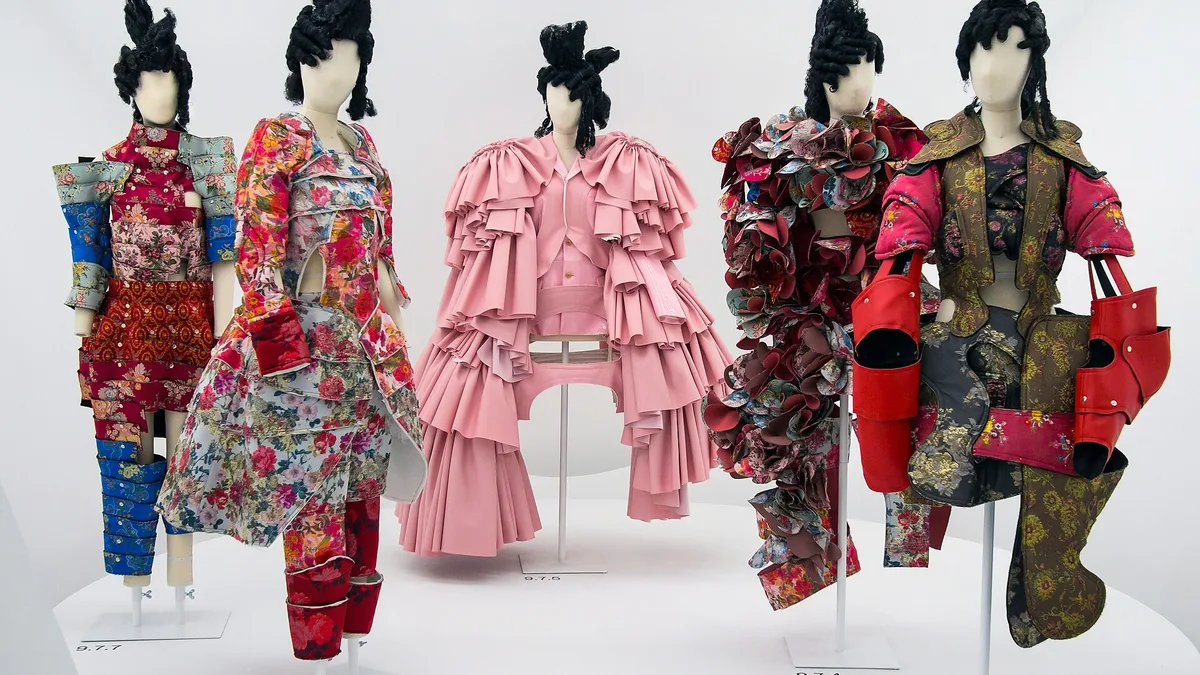
Comme Des Garcons
| Designer | Rei Kawakubo |
|---|---|
| First created | 1973 |
| Country of origin | Japan |
| Original use | Avant-garde fashion |
| Shows | Paris Fashion Week (Women's), Paris Fashion Week (Men's) |
| Retail availability | Seasonal collections in Comme des Garçons boutiques and select stockists |
Origin and history
Comme Des Garçons is a Japanese fashion label founded by designer Rei Kawakubo. The company was established in Tokyo in the late 1960s, with its first boutique opening in 1975. Kawakubo presented her first Paris Fashion Week collection in 1981, which immediately challenged Western sartorial norms with its avant-garde, deconstructed aesthetic. The brand's name, French for "like boys," hints at its early exploration of androgyny and rejection of overtly feminine silhouettes. Over decades, it has grown into a multi-faceted empire encompassing multiple clothing lines, fragrances, and the influential Dover Street Market retail concept. Its history is defined by a consistent philosophical commitment to anti-fashion, conceptual art, and intellectual provocation within the commercial fashion system.
What it is for
Comme Des Garçons produces conceptual clothing and accessories that function as wearable art and personal expression. Its primary purpose is not to create conventionally flattering or trend-driven items but to challenge perceptions of beauty, form, and the body. The collections serve as a medium for Rei Kawakubo's ongoing artistic exploration of themes like imperfection, disruption, and the space between boundaries. For the wearer, the clothing is intended to provoke thought, convey a specific intellectual or aesthetic stance, and assert a distinct identity separate from mainstream fashion. Commercially, the brand operates through its own standalone boutiques, select high-end stockists, and its Dover Street Market stores, which curate a total environment for its vision. It also licenses fragrances and collaborates with other brands, extending its conceptual framework into different product categories.
Overview
Comme Des Garçons is a globally influential fashion house renowned for its radical, intellectual, and often challenging approach to design. It operates through a constellation of distinct lines, including the main women's and men's collections, the more accessible Comme Des Garçons PLAY, the tailored Comme Des Garçons Noir, and the shirt-focused Comme Des Garçons Shirt. The brand's creative output is inseparable from the vision of its founder, Rei Kawakubo, who remains the sole designer for the core collections. Its commercial presence is carefully controlled through direct retail and exclusive partnerships, maintaining an aura of rarity and discernment. The overarching concept of the brand consistently prioritizes idea over wearability, though many pieces are designed to be lived in. It exists as a cornerstone of avant-garde fashion, continuously questioning the definitions and functions of clothing.
What to know
The main Comme Des Garçons collections are presented on the official Paris Fashion Week schedule, typically for women's in March and September/October and for men's in January and June. Only a fraction of the runway pieces are produced for sale, with even fewer arriving at retail, making some items essentially conceptual artworks. The brand's retail strategy is pivotal, with its own boutiques and Dover Street Market stores offering the full experiential context for the clothing. Prices are high, reflecting the complex construction, unique fabrics, and artistic value, with mainline garments often costing several thousand dollars. Understanding the difference between the various sub-lines is crucial, as each has a different price point, aesthetic, and purpose, from the artistic mainline to the graphic-driven PLAY. The brand rarely explains its collections narratively, preferring that the clothing and its presentation communicate its often abstract themes directly to the viewer.
Common questions
A frequent question is whether Comme Des Garçons clothing is meant to be worn by everyday people, given its unconventional forms; the answer is yes, but it requires a wearer comfortable with drawing attention and interpreting the pieces for their own body. Many ask about the meaning behind specific collections, to which there is rarely a single answer, as Kawakubo intentionally avoids literal explanations to encourage personal interpretation. People often inquire about the difference between Comme Des Garçons and Comme Des Garçons PLAY, with the latter being a diffusion line featuring the iconic heart logo, offering more casual and affordable basics. Another common question concerns sizing, which is often intentionally non-standard, oversized, or based on Japanese measurements, necessitating consultation of specific garment measurements rather than standard size charts. Customers also ask where to buy the brand, with the primary sources being official Comme Des Garçons boutiques in major cities, Dover Street Market locations, and a very limited number of authorized high-end retailers. Finally, many wonder about the longevity and investment value of the pieces, which are generally considered durable and often become coveted archival items, though this is not the brand's primary intention.
Pros and cons
The construction, fabric innovation, and attention to detail are typically exceptional, resulting in garments that are intellectually and tactilely stimulating. A major con is the high cost, which places the clothing out of reach for most and can lead to regret if the wearer finds the avant-garde silhouette too challenging for daily life after purchase. The fit is often deliberately unconventional, which can be a pro for those seeking unique forms but a con for anyone expecting traditional, body-flattering tailoring, leading to difficult alterations. Another con is the potential for social discomfort or misunderstanding, as the clothing can attract stares or negative comments in non-fashion environments, requiring a resilient personality. The brand's intentional obscurity and lack of explanatory guidance can also be a barrier, making it difficult for new audiences to understand or access the philosophy behind the pieces they are considering.
Who it suits
Comme Des Garçons best suits individuals who prioritize conceptual artistic expression over conventional attractiveness or trend-following in their clothing. It appeals to collectors, archivists, and those who view fashion as an art form, willing to invest in pieces as moving cultural artifacts. The wearer typically possesses a strong, confident sense of self and is comfortable being perceived as different or challenging within their social or professional environment. It suits people with a deep interest in fashion history, theory, and the mechanics of garment construction, who appreciate the intellectual narrative behind what they wear. Physically, the clothing often suits those who are open to exploring silhouette and volume rather than seeking pieces that emphasize or cinch the natural body shape. Ultimately, it is for those who find mainstream luxury fashion lacking in substance and seek a brand with a consistent, uncompromising philosophical core.